AIBE XXI Syllabus 2026: Complete Subject-Wise Syllabus & Question Weightage

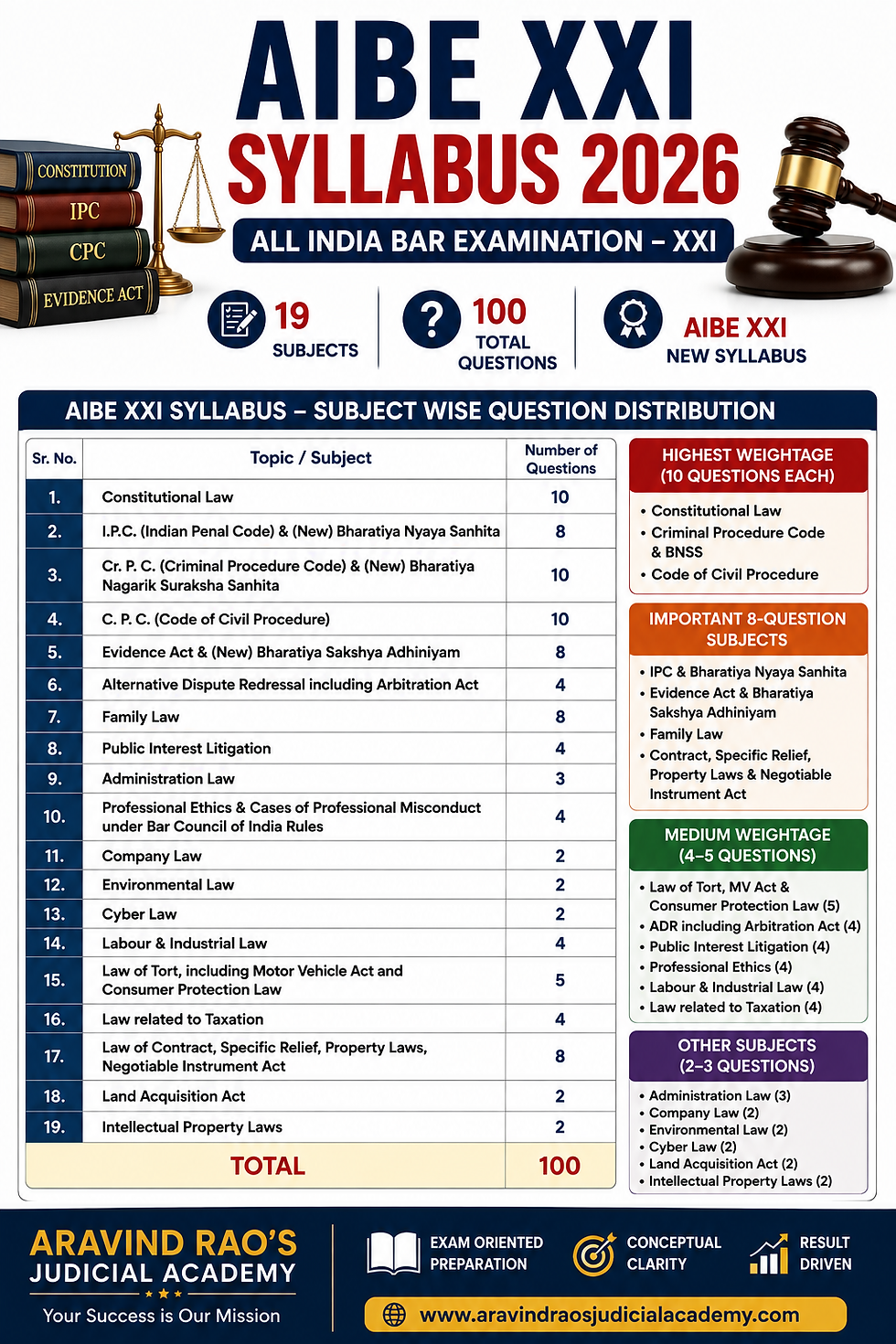
Are you preparing for the All India Bar Examination XXI (AIBE XXI)?
The Bar Council of India Trust has released the syllabus for All India Bar Exam-XXI, dated 2 March 2026. The syllabus covers 19 subjects/topics and a total of 100 questions, with significant weightage given to Constitutional Law, Criminal Procedure, Civil Procedure, Criminal Law, Evidence, Family Law and core civil laws.
For AIBE aspirants, understanding the subject-wise number of questions is the first step towards building an effective preparation and revision strategy.
Here is the complete AIBE XXI syllabus and subject-wise question distribution.
AIBE XXI 2026 Syllabus at a Glance
According to the official syllabus, the examination covers 19 areas of law for a total of 100 questions.
S. No. | Topic / Subject | Questions |
1 | Constitutional Law | 10 |
2 | I.P.C. (Indian Penal Code) & (New) Bharatiya Nyaya Sanhita | 8 |
3 | Cr. P. C. (Criminal Procedure Code) & (New) Bharatiya Nagarik Suraksha Sanhita | 10 |
4 | C. P. C. (Code of Civil Procedure) | 10 |
5 | Evidence Act & (New) Bharatiya Sakshya Adhiniyam | 8 |
6 | Alternative Dispute Redressal including Arbitration Act | 4 |
7 | Family Law | 8 |
8 | Public Interest Litigation | 4 |
9 | Administration Law | 3 |
10 | Professional Ethics & Cases of Professional Misconduct under Bar Council of India Rules | 4 |
11 | Company Law | 2 |
12 | Environmental Law | 2 |
13 | Cyber Law | 2 |
14 | Labour & Industrial Law | 4 |
15 | Law of Tort, including Motor Vehicle Act and Consumer Protection Law | 5 |
16 | Law related to Taxation | 4 |
17 | Law of Contract, Specific Relief, Property Laws, Negotiable Instrument Act | 8 |
18 | Land Acquisition Act | 2 |
19 | Intellectual Property Laws | 2 |
Total | 100 |
1. Constitutional Law – 10 Questions
Constitutional Law carries 10 questions, making it one of the highest-weightage subjects in AIBE XXI.
Aspirants should ensure that their preparation of Constitutional Law is comprehensive and revision-oriented.
Important areas generally associated with Constitutional Law preparation include constitutional provisions, fundamental constitutional principles, rights, institutions and important constitutional concepts.
Since the official syllabus allocates 10 questions to the subject, Constitutional Law should be treated as a high-priority area.
2. IPC & Bharatiya Nyaya Sanhita – 8 Questions
The AIBE XXI syllabus specifically includes:
I.P.C. (Indian Penal Code) & (New) Bharatiya Nyaya Sanhita
This section carries 8 questions.
The presence of both the Indian Penal Code and the Bharatiya Nyaya Sanhita in the official syllabus is particularly important for candidates.
Aspirants should therefore ensure that their study material reflects the terminology used in the updated AIBE XXI syllabus.
3. Criminal Procedure Code & Bharatiya Nagarik Suraksha Sanhita – 10 Questions
Criminal Procedure is another major scoring area.
The syllabus lists:
Cr. P. C. (Criminal Procedure Code) & (New) Bharatiya Nagarik Suraksha Sanhita
Weightage: 10 Questions
With 10 questions, this subject receives the joint-highest individual weightage in AIBE XXI.
Candidates should therefore give Criminal Procedure substantial time during both preparation and final revision.
4. Code of Civil Procedure – 10 Questions
The Code of Civil Procedure (CPC) carries:
10 Questions
This makes CPC another high-weightage subject.
For law graduates and practising advocates appearing for the AIBE, procedural law is an important area because it connects substantive legal rights with their enforcement before courts.
A systematic revision of CPC should therefore form a central part of AIBE XXI preparation.
5. Evidence Act & Bharatiya Sakshya Adhiniyam – 8 Questions
The official syllabus includes:
Evidence Act & (New) Bharatiya Sakshya Adhiniyam
Weightage: 8 Questions
This is another important section where candidates should pay attention to both the traditional and new statutory terminology mentioned in the syllabus.
With 8 questions, Evidence deserves serious preparation.
6. Alternative Dispute Redressal Including Arbitration Act – 4 Questions
ADR has been allotted:
4 Questions
The syllabus specifically refers to:
Alternative Dispute Redressal including Arbitration Act
Candidates should therefore include ADR and arbitration-related concepts in their preparation rather than focusing only on courtroom litigation subjects.
7. Family Law – 8 Questions
Family Law carries 8 questions, giving it substantial weightage.
Students should avoid treating Family Law as a secondary subject.
In terms of the official question distribution, Family Law carries the same number of questions as:
IPC/Bharatiya Nyaya Sanhita
Evidence Act/Bharatiya Sakshya Adhiniyam
The combined Contract, Specific Relief, Property and Negotiable Instruments section
This makes Family Law an important scoring area.
8. Public Interest Litigation – 4 Questions
The syllabus allocates:
4 Questions to Public Interest Litigation
PIL is therefore a separate identifiable area in the AIBE XXI syllabus.
Aspirants should ensure that Public Interest Litigation is included as an independent revision topic.
9. Administration Law – 3 Questions
The official AIBE XXI syllabus lists:
Administration Law – 3 Questions
Candidates should allocate proportionate revision time to this subject while ensuring basic conceptual clarity.
10. Professional Ethics & Professional Misconduct – 4 Questions
This subject is particularly relevant to an examination designed for advocates.
The syllabus specifies:
Professional Ethics & Cases of Professional Misconduct under Bar Council of India Rules
Weightage: 4 Questions
Candidates should not overlook Professional Ethics during their preparation.
The area directly relates to the professional standards, conduct and responsibilities governing advocates.
11. Company Law – 2 Questions
Company Law carries 2 questions.
Although the weightage is comparatively lower, every question matters in an objective examination.
A concise and targeted revision strategy is advisable for such lower-weightage subjects.
12. Environmental Law – 2 Questions
The official syllabus allocates:
2 Questions
to Environmental Law.
Candidates should prepare the subject according to its proportionate weightage.
13. Cyber Law – 2 Questions
Cyber Law carries 2 questions.
As with other two-question subjects, candidates should aim for focused preparation of essential concepts rather than leaving the subject completely untouched.
14. Labour & Industrial Law – 4 Questions
The official syllabus prescribes:
Labour & Industrial Law – 4 Questions
This area should be included in the main revision cycle alongside ADR, PIL, Professional Ethics and Taxation, which also carry four questions each.
15. Law of Tort, Motor Vehicle Act & Consumer Protection Law – 5 Questions
The syllabus combines:
Law of Tort
Motor Vehicle Act
Consumer Protection Law
Total Weightage: 5 Questions
This is an important combined subject area.
Candidates should note that the official syllabus expressly includes the Motor Vehicle Act and Consumer Protection Law along with the Law of Tort.
16. Law Related to Taxation – 4 Questions
Law related to Taxation carries 4 questions.
Candidates should ensure that taxation is not omitted from preparation merely because it is outside the larger procedural-law subjects.
Four questions can make a meaningful difference to the final score.
17. Contract, Specific Relief, Property Laws & Negotiable Instrument Act – 8 Questions
One of the broader subject groups in AIBE XXI covers:
Law of Contract
Specific Relief
Property Laws
Negotiable Instrument Act
Total Weightage: 8 Questions
Because several important laws are grouped under these 8 questions, candidates should plan this portion carefully.
It is advisable to divide this group into smaller revision modules rather than attempting to revise all four areas together at the last moment.
18. Land Acquisition Act – 2 Questions
The Land Acquisition Act carries 2 questions.
Although the numerical weightage is limited, it remains an expressly prescribed component of the official syllabus and should therefore be included in preparation.
19. Intellectual Property Laws – 2 Questions
The final subject listed in the official AIBE XXI syllabus is:
Intellectual Property Laws – 2 Questions
Candidates should cover the fundamental aspects of IPR relevant to the examination.
Highest Weightage Subjects in AIBE XXI
Based strictly on the official subject distribution, the highest-weightage subjects are:
10 Questions Each
Constitutional Law – 10
Criminal Procedure Code & Bharatiya Nagarik Suraksha Sanhita – 10
Code of Civil Procedure – 10
Together, these three areas account for:
30 Questions
That means a strong command over these subjects can have a major impact on overall performance.
Next Priority: 8-Question Subjects
The following subjects carry 8 questions each:
IPC & Bharatiya Nyaya Sanhita
Evidence Act & Bharatiya Sakshya Adhiniyam
Family Law
Law of Contract, Specific Relief, Property Laws & Negotiable Instrument Act
Together, these four areas contribute:
32 Questions
Therefore, the 10-question and 8-question subjects together account for 62 questions out of the 100-question syllabus.
This makes them extremely important from a preparation-planning perspective.
AIBE XXI Subject-Wise Priority Strategy
A practical way of arranging revision is:
Priority 1 – Highest Weightage
Constitutional Law – 10
Criminal Procedure/BNSS – 10
CPC – 10
Priority 2 – Major 8-Question Areas
IPC/BNS – 8
Evidence/BSA – 8
Family Law – 8
Contract + Specific Relief + Property + Negotiable Instrument Act – 8
Priority 3 – Medium Weightage
Law of Tort + Motor Vehicle Act + Consumer Protection Law – 5
ADR including Arbitration – 4
Public Interest Litigation – 4
Professional Ethics – 4
Labour & Industrial Law – 4
Taxation – 4
Priority 4 – Smaller Weightage Areas
Administration Law – 3
Company Law – 2
Environmental Law – 2
Cyber Law – 2
Land Acquisition Act – 2
Intellectual Property Laws – 2
This priority classification is based solely on the number of questions shown in the official syllabus.
New Criminal Laws Are Important for AIBE XXI
One of the most noticeable features of the AIBE XXI syllabus is the express reference to the new criminal laws.
The syllabus mentions:
IPC + Bharatiya Nyaya Sanhita
CrPC + Bharatiya Nagarik Suraksha Sanhita
Evidence Act + Bharatiya Sakshya Adhiniyam
Therefore, candidates preparing from older AIBE material should check whether their notes and books adequately reflect the terminology and coverage prescribed in the AIBE XXI syllabus.
AIBE XXI 2026 Preparation Checklist
Before completing your preparation, make sure you have covered all 19 areas:
✅ Constitutional Law✅ IPC & Bharatiya Nyaya Sanhita✅ Criminal Procedure Code & Bharatiya Nagarik Suraksha Sanhita✅ Code of Civil Procedure✅ Evidence Act & Bharatiya Sakshya Adhiniyam✅ Alternative Dispute Redressal including Arbitration✅ Family Law✅ Public Interest Litigation✅ Administration Law✅ Professional Ethics & Professional Misconduct✅ Company Law✅ Environmental Law✅ Cyber Law✅ Labour & Industrial Law✅ Tort, Motor Vehicle Act & Consumer Protection Law✅ Taxation✅ Contract, Specific Relief, Property & Negotiable Instrument Act✅ Land Acquisition Act✅ Intellectual Property Laws
How Should You Prepare for AIBE XXI?
The key is to prepare according to the official weightage rather than studying every subject with equal intensity.
Start with the 10-question and 8-question subjects, but do not completely neglect the smaller subjects.
A structured approach can be:
Study → Bare Act/Concept Revision → Question Practice → Repeat Revision
Candidates should particularly ensure that their materials are updated for the criminal-law subjects expressly identified in the AIBE XXI syllabus.
Final Word for AIBE XXI Aspirants
The AIBE XXI syllabus gives aspirants a clear roadmap.
There are 100 questions distributed across 19 subject areas, but the weightage is not equal.
The most effective preparation strategy is therefore to combine:
High-weightage subject preparation + systematic coverage of all subjects + repeated revision + objective question practice.
Do not wait until the final weeks to identify which subjects carry the most questions.
Build your preparation around the official syllabus from the beginning.
For structured AIBE preparation, legal concepts, exam-oriented classes and revision support, aspirants can follow Aravind Rao’s Judicial Academy.
Prepare with the syllabus. Revise with a strategy. Practise for accuracy.
Comments