TG PGLCET Syllabus | Complete Subject-Wise LL.M Entrance Exam Pattern & Preparation Guide | MUST READ

Are you preparing for TG PGLCET 2026 for admission into LL.M. courses in Telangana?
The first and most important step towards effective preparation is to understand the complete PGLCET syllabus, examination pattern, subject-wise weightage and important topics.
The official syllabus for TS PGLCET-2026 makes it clear that candidates are expected to have a thorough understanding of major areas of law including Jurisprudence, Constitutional Law, Public International Law, Business and Corporate Laws, Labour Laws, Crimes and Torts, and Other Allied Laws.
For every serious LL.M. aspirant, understanding the weightage of each subject can make preparation far more organised and examination-oriented.
Here is the complete TG/TS PGLCET 2026 syllabus and exam pattern in a simple and easy-to-follow format.
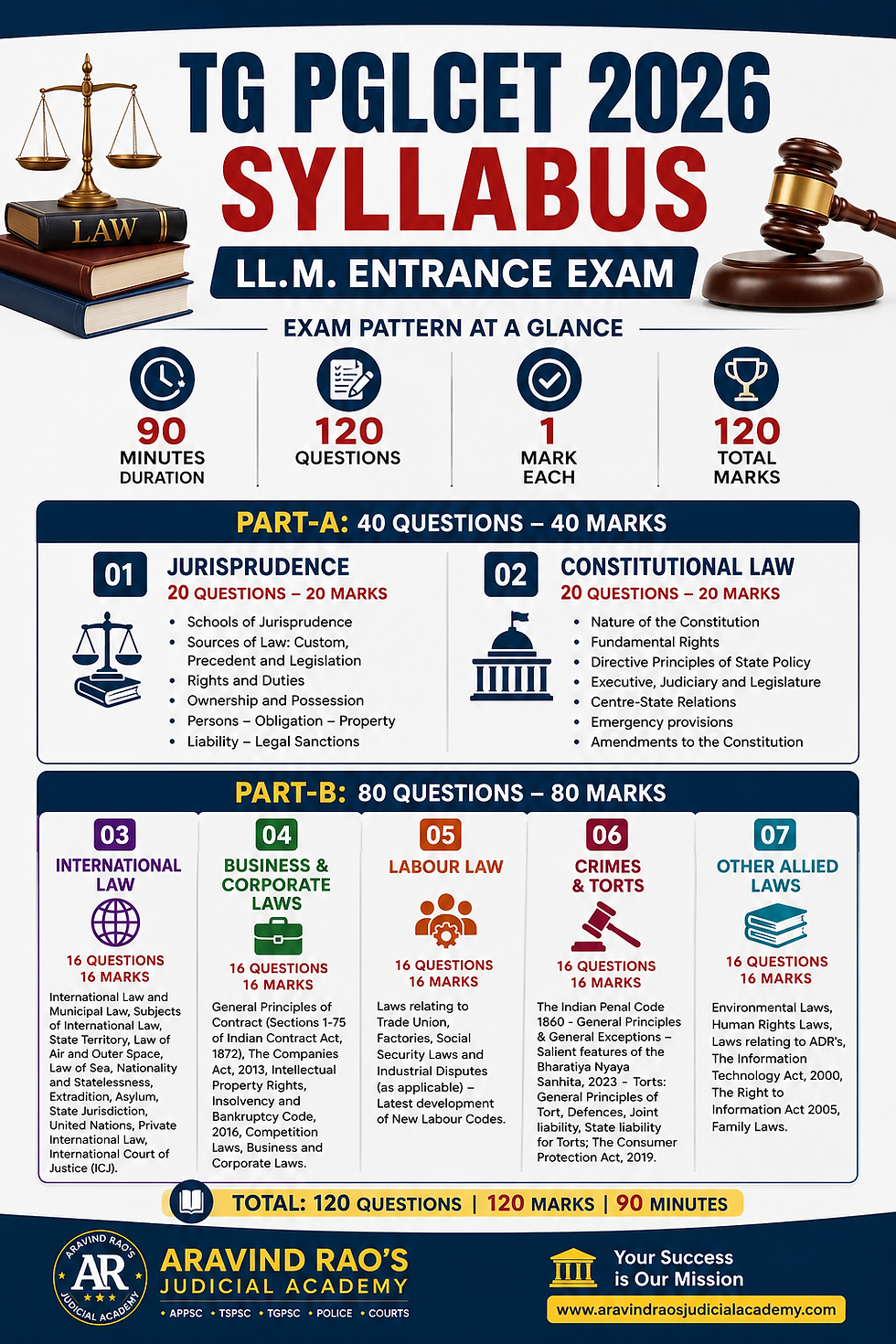
TG PGLCET 2026 Exam Pattern – At a Glance
The PGLCET is a common entrance examination conducted for admission into various LL.M. courses and specialisations.
Examination Pattern
Particulars | Details |
Examination | TS/TG PGLCET 2026 |
Course | LL.M. |
Duration | 90 Minutes |
Total Questions | 120 Questions |
Marks per Question | 1 Mark |
Total Marks | 120 Marks |
Part-A | 40 Questions – 40 Marks |
Part-B | 80 Questions – 80 Marks |
The examination is therefore divided into two major parts – Part-A and Part-B.
PART-A – 40 Questions | 40 Marks
Part-A consists of two foundational law subjects:
Jurisprudence – 20 Questions
Constitutional Law – 20 Questions
These two subjects together account for 40 marks.
1. JURISPRUDENCE – 20 Questions | 20 Marks
Jurisprudence is one of the most important conceptual subjects in the PGLCET examination.
Candidates should concentrate on the following topics:
Important Topics in Jurisprudence
Schools of Jurisprudence
Sources of Law
Custom
Precedent
Legislation
Rights and Duties
Ownership and Possession
Persons
Obligation
Property
Liability
Legal Sanctions
How to Prepare Jurisprudence for PGLCET 2026?
Jurisprudence should not be treated merely as a theoretical subject.
Candidates must clearly understand the basic legal concepts and distinctions between topics such as:
Rights and duties
Ownership and possession
Different sources of law
Liability
Legal persons
Obligations
Since 20 questions are allotted to Jurisprudence, strong conceptual preparation in this subject can make a significant difference to the overall score.
2. CONSTITUTIONAL LAW – 20 Questions | 20 Marks
Constitutional Law is another major component of Part-A.
The syllabus covers important constitutional institutions, principles and provisions.
Important Constitutional Law Topics
Candidates should prepare:
Nature of the Constitution
Fundamental Rights
Directive Principles of State Policy
Executive
Judiciary
Legislature
Centre-State Relations
Emergency Provisions
Amendments to the Constitution
Preparation Focus
While preparing Constitutional Law, aspirants should develop clarity regarding the constitutional framework and the relationship between different organs of the State.
Special attention should be given to:
Fundamental Rights + Directive Principles + Centre-State Relations + Emergency Provisions + Constitutional Amendments.
Together, Jurisprudence and Constitutional Law constitute the entire 40 marks of Part-A, making these subjects extremely important for PGLCET preparation.
PART-B – 80 Questions | 80 Marks
Part-B consists of five subject groups, carrying 16 questions and 16 marks each.
The subjects are:
International Law
Business and Corporate Laws
Labour Law
Crimes and Torts
Other Allied Laws
Let us examine each subject in detail.
3. INTERNATIONAL LAW – 16 Questions | 16 Marks
International Law carries 16 marks in the examination.
Complete International Law Syllabus
Candidates should prepare:
International Law and Municipal Law
Subjects of International Law
State Territory
Law of Air and Outer Space
Law of Sea
Nationality and Statelessness
Extradition
Asylum
State Jurisdiction
United Nations
Private International Law
International Court of Justice (ICJ)
Areas Requiring Special Attention
International Law contains several concept-based topics where candidates should understand both basic principles and terminology.
Important areas include:
Municipal Law vs International Law, State Jurisdiction, Extradition, Asylum, Nationality, Law of Sea, United Nations and ICJ.
4. BUSINESS AND CORPORATE LAWS – 16 Questions | 16 Marks
Business and Corporate Laws form another important 16-mark component of Part-B.
Complete Syllabus
The official syllabus includes:
General Principles of Contract
Sections 1–75 of the Indian Contract Act, 1872
Companies Act, 2013
Intellectual Property Rights
Insolvency and Bankruptcy Code, 2016
Competition Laws
Business and Corporate Laws
Indian Contract Act – Important Focus
Candidates should particularly note that the prescribed Contract Law portion refers to Sections 1 to 75 of the Indian Contract Act, 1872.
Therefore, your preparation should include the general principles relating to the formation, validity and enforcement of contracts covered within the prescribed portion.
Corporate-law preparation should also include the basic framework and important concepts under:
Companies Act, 2013
Intellectual Property Rights
Insolvency and Bankruptcy Code, 2016
Competition Laws
5. LABOUR LAW – 16 Questions | 16 Marks
Labour Law carries 16 questions for 16 marks.
Labour Law Syllabus
The prescribed areas include laws relating to:
Trade Unions
Factories
Social Security Laws
Industrial Disputes
Latest developments relating to the New Labour Codes
IMPORTANT FOR PGLCET 2026
The syllabus specifically refers to latest developments of the New Labour Codes.
Therefore, candidates should not depend entirely upon old Labour Law notes.
Preparation should cover the prescribed labour-law concepts together with relevant developments connected with the new Labour Codes.
6. CRIMES AND TORTS – 16 Questions | 16 Marks
This section combines Criminal Law and Law of Torts.
Criminal Law Portion
The syllabus includes:
Indian Penal Code, 1860
General Principles
General Exceptions
Salient Features of the Bharatiya Nyaya Sanhita, 2023
The specific inclusion of the Bharatiya Nyaya Sanhita, 2023 (BNS) makes updated preparation particularly important.
Candidates should therefore pay attention to the transition in criminal law while studying the topics specified in the syllabus.
Law of Torts Portion
The prescribed Tort Law topics include:
General Principles of Tort
Defences
Joint Liability
State Liability for Torts
Consumer Protection Act, 2019
Students should understand the fundamental principles behind tortious liability rather than relying only upon isolated definitions.
The Consumer Protection Act, 2019 is also expressly included within this subject group.
7. OTHER ALLIED LAWS – 16 Questions | 16 Marks
The final 16-mark component covers a wide range of allied laws.
Complete Other Allied Laws Syllabus
Candidates should prepare:
Environmental Laws
Human Rights Laws
Laws relating to ADRs
Information Technology Act, 2000
Right to Information Act, 2005
Family Laws
Since this portion brings several different statutes and legal areas under one subject group, students should prepare it systematically rather than leaving it until the end.
TG PGLCET 2026 Subject-Wise Weightage
Here is the complete marks distribution:
Subject | Questions | Marks |
Jurisprudence | 20 | 20 |
Constitutional Law | 20 | 20 |
International Law | 16 | 16 |
Business & Corporate Laws | 16 | 16 |
Labour Law | 16 | 16 |
Crimes & Torts | 16 | 16 |
Other Allied Laws | 16 | 16 |
TOTAL | 120 | 120 |
Which Subjects Carry the Highest Weightage in PGLCET 2026?
From the official subject distribution, Jurisprudence and Constitutional Law carry the highest individual weightage, with 20 questions each.
The remaining five subject groups carry 16 questions each.
Therefore, students should not make the mistake of concentrating on only one or two popular subjects.
The examination has a broad-based syllabus, and balanced preparation across all seven subject areas is essential.
Smart Preparation Strategy for TG PGLCET 2026
1. Start with Jurisprudence and Constitutional Law
Together these subjects carry:
40 Questions = 40 Marks
Build strong conceptual clarity in these two subjects first.
2. Divide Part-B into Five Equal Modules
Each Part-B subject carries exactly 16 marks.
Prepare them as five separate modules:
Module 1: International LawModule 2: Business & Corporate LawsModule 3: Labour LawModule 4: Crimes & TortsModule 5: Other Allied Laws
This makes the 80-mark Part-B syllabus easier to organise.
3. Do Not Ignore New Legislative Developments
The official syllabus itself specifically refers to:
Bharatiya Nyaya Sanhita, 2023
Latest developments of the New Labour Codes
Therefore, preparation based entirely on outdated materials may leave important gaps.
4. Prepare Statute-Based Subjects Carefully
Several areas of the syllabus are linked directly to statutes, including:
Indian Contract Act, 1872
Companies Act, 2013
Insolvency and Bankruptcy Code, 2016
Consumer Protection Act, 2019
Information Technology Act, 2000
Right to Information Act, 2005
Students should understand important statutory concepts, provisions and terminology relevant to the prescribed syllabus.
5. Practise MCQs Regularly
PGLCET is an objective entrance examination.
Knowing the law is only the first step.
Students should also practise identifying the correct answer quickly among closely worded alternatives.
Regular MCQ practice helps improve:
Legal recall
Accuracy
Conceptual clarity
Question selection
Speed
6. Prepare According to Weightage
A practical revision plan can broadly follow this order:
First Priority:Jurisprudence + Constitutional Law
Second Priority:International Law + Business & Corporate Laws + Labour Law + Crimes & Torts
Third Priority:Systematic revision of Other Allied Laws
However, since every prescribed subject contributes directly to the final score, no subject should be completely ignored.
90 Minutes for 120 Questions – Why Practice Matters
The examination consists of 120 questions to be attempted within 90 minutes.
That means candidates cannot afford to spend excessive time recalling every concept during the examination.
Preparation should therefore be aimed at developing:
Concept → Recall → Recognition → Correct Answer
The more familiar you become with examination-oriented MCQs, the faster this process becomes.
Final Word for TG PGLCET 2026 Aspirants
PGLCET preparation does not require random reading of every law subject studied during LL.B.
It requires focused preparation according to the prescribed syllabus and subject-wise weightage.
Remember the basic structure:
120 Questions | 120 Marks | 90 Minutes
Part-A:40 Questions – Jurisprudence & Constitutional Law
Part-B:80 Questions – International Law, Business & Corporate Laws, Labour Law, Crimes & Torts and Other Allied Laws
Start early, revise systematically and practise objective questions regularly.
Aspirants looking for structured and examination-oriented guidance for TG PGLCET LL.M. Entrance Examination can explore the preparation resources and guidance available from Aravind Rao's Judicial Academy.
Prepare according to the syllabus. Practise according to the examination. Revise with a strategy.
All the best for TG PGLCET 2026!
TAGS
TG PGLCET 2026 syllabus, PGLCET 2026 syllabus, TG PGLCET syllabus 2026, Telangana PGLCET 2026, TS PGLCET 2026 syllabus, PGLCET LL.M syllabus, TG PGLCET exam pattern, PGLCET subject wise marks, PGLCET preparation 2026, LL.M entrance exam Telangana, PGLCET Jurisprudence syllabus, PGLCET Constitutional Law syllabus, TG PGLCET coaching Hyderabad, PGLCET books, Aravind Rao Judicial Academy
Comments