Telangana JCJ Old vs New Syllabus: Complete Comparison of 2022 and 2023 Civil Judge Syllabus

By Aravind Rao’s Judicial Academy
The Telangana Civil Judge (Junior Division) syllabus underwent an important expansion between the 2022 recruitment notification and the 2023 recruitment notification issued by the High Court for the State of Telangana.
For Judiciary aspirants, understanding the difference between the old Telangana JCJ syllabus and the new Telangana JCJ syllabus is extremely important. While most of the traditional core subjects such as CPC, Contract, Transfer of Property, CrPC, IPC and Evidence continued, the newer syllabus added several important Central and State enactments.
This article provides a subject-by-subject comparison of the Telangana JCJ 2022 syllabus and Telangana JCJ 2023 syllabus.
Telangana JCJ Old vs New Syllabus – At a Glance
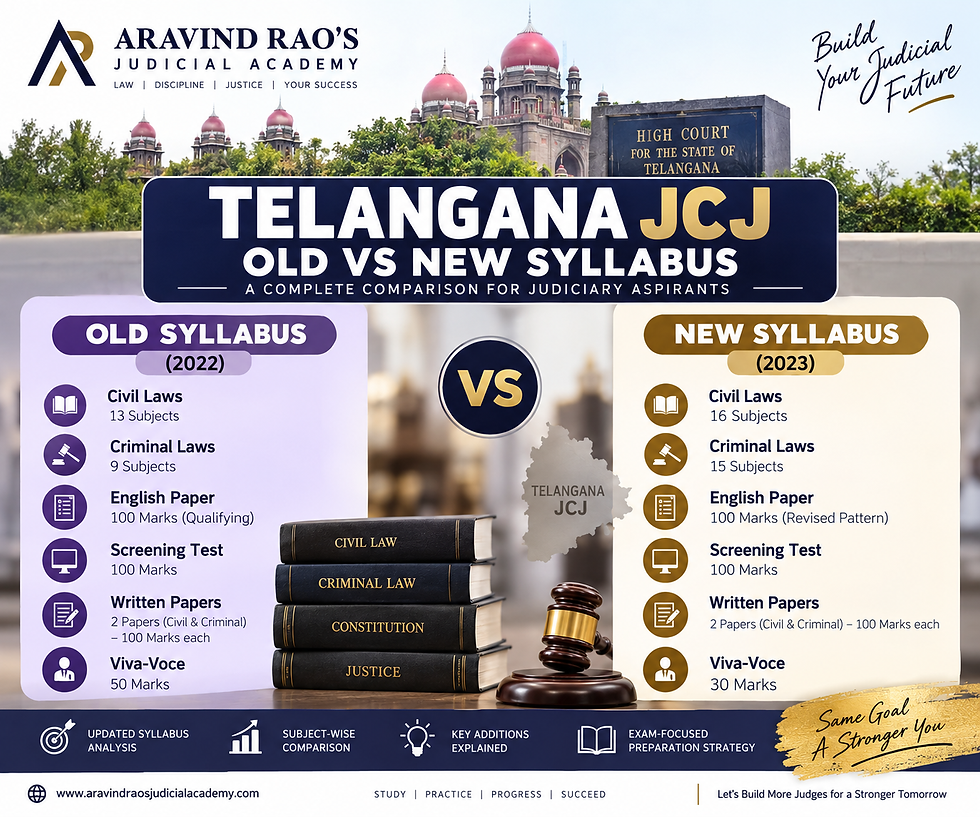
Particular | Old Syllabus – 2022 | New Syllabus – 2023 |
Civil Law subjects/listed heads | 13 | 16 |
Criminal Law subjects/listed heads | 9 | 15 |
English Paper | 100 Marks | 100 Marks |
Civil Laws Paper | 100 Marks | 100 Marks |
Criminal Laws Paper | 100 Marks | 100 Marks |
Viva-Voce | 50 Marks | 30 Marks |
Screening Test | 100 Marks | 100 Marks |
The 2022 notification listed 13 heads under Civil Laws and 9 under Criminal Laws, whereas the 2023 notification expanded the Civil and Criminal portions substantially.
Telangana JCJ Civil Law Syllabus: Old vs New
Old Civil Law Syllabus – Telangana JCJ 2022
The 2022 notification prescribed the following Civil Law syllabus:
Code of Civil Procedure, 1908
Indian Contract Act, 1872
Hindu Marriage Act, 1955
Hindu Succession Act, 1956
Indian Easements Act, 1882
Specific Relief Act, 1963
Limitation Act, 1963
Transfer of Property Act, 1882
Civil Rules of Practice
Registration Act, 1908 and Indian Stamp Act, 1899
Telangana Land Encroachment Act, 1905
Telangana Buildings (Lease, Rent & Eviction) Control Act, 1960
Indian Evidence Act, 1872
These subjects were expressly listed in the 2022 notification.
New Civil Law Syllabus – Telangana JCJ 2023
The 2023 notification prescribed the following Civil Laws:
Code of Civil Procedure, 1908 along with Civil Rules of Practice
Indian Contract Act, 1872 and Sale of Goods Act
Indian Evidence Act, 1872
Hindu Succession Act, 1956
Hindu Marriage Act, 1955
Specific Relief Act, 1963
Indian Easements Act, 1882
Limitation Act, 1963
Transfer of Property Act, 1882
Indian Stamp Act, 1899 and Registration Act, 1908
Commercial Courts, Commercial Division and Commercial Appellate Division of High Courts Act, 2015
Indian Succession Act, 1925
Laws relating to Hindu Adoption, Guardianship and Maintenance
Legal Services Authorities Act, 1987
Telangana Land Encroachment Act, 1905
Telangana Buildings (Lease, Rent & Eviction) Control Act, 1960
The expanded Civil Law list appears in the 2023 notification.
Civil Laws: What Was Added in the New Telangana JCJ Syllabus?
The most important change is that the 2023 syllabus did not merely repeat the old subjects. It broadened the Civil Law portion.
Important additions include:
1. Sale of Goods Act
The 2023 notification expressly combines the Indian Contract Act, 1872 with the Sale of Goods Act.
This makes Sale of Goods an express part of the notified syllabus rather than leaving candidates to treat it merely as an allied commercial-law topic.
2. Commercial Courts Act, 2015
One of the important additions is the law relating to:
Commercial Courts, Commercial Division and Commercial Appellate Division of High Courts Act, 2015.
This expands the syllabus into modern commercial litigation and commercial dispute procedure.
3. Indian Succession Act, 1925
The Indian Succession Act, 1925 was separately included in the 2023 syllabus.
This means succession law requires wider preparation beyond Hindu Succession alone.
4. Hindu Adoption, Guardianship and Maintenance Laws
The new syllabus separately includes laws relating to:
Hindu Adoption;
Guardianship; and
Maintenance.
This broadens the family-law component of the examination.
5. Legal Services Authorities Act, 1987
The Legal Services Authorities Act, 1987 was also added to the syllabus.
Judiciary aspirants must therefore understand topics such as legal aid, Lok Adalats and the statutory legal-services framework.
Civil Law Comparison Table
Subject | 2022 | 2023 |
CPC | ✅ | ✅ |
Civil Rules of Practice | ✅ | ✅ |
Contract Act | ✅ | ✅ |
Sale of Goods Act | — | ✅ |
Evidence Act | ✅ | ✅ |
Hindu Marriage Act | ✅ | ✅ |
Hindu Succession Act | ✅ | ✅ |
Easements Act | ✅ | ✅ |
Specific Relief Act | ✅ | ✅ |
Limitation Act | ✅ | ✅ |
Transfer of Property Act | ✅ | ✅ |
Registration Act | ✅ | ✅ |
Stamp Act | ✅ | ✅ |
Telangana Land Encroachment Act | ✅ | ✅ |
Telangana Buildings Rent Law | ✅ | ✅ |
Commercial Courts Act | — | ✅ |
Indian Succession Act | — | ✅ |
Hindu Adoption/Guardianship/Maintenance Laws | — | ✅ |
Legal Services Authorities Act | — | ✅ |
Major takeaway
The core Civil Law foundation remained intact, but the new Telangana JCJ syllabus widened the scope considerably, especially in commercial law, succession law, family law and legal services.
Telangana JCJ Criminal Law Syllabus: Old vs New
The expansion is even more noticeable in Criminal Laws.
Old Criminal Law Syllabus – Telangana JCJ 2022
The 2022 notification contained the following Criminal Law syllabus:
Code of Criminal Procedure, 1973
Indian Penal Code, 1860
Indian Evidence Act, 1872
Negotiable Instruments Act, 1881
Protection of Women from Domestic Violence Act, 2005
Criminal Rules of Practice
Telangana Excise Act, 1968
Telangana Gaming Act, 1974
Juvenile Justice (Care and Protection of Children) Act
New Criminal Law Syllabus – Telangana JCJ 2023
The 2023 syllabus contained:
Code of Criminal Procedure, 1973
Indian Evidence Act, 1872
Indian Penal Code, 1860
Negotiable Instruments Act, 1881 – Sections 138 to 148-A
Telangana Prohibition Act, 1995
Telangana Excise Act, 1968
Juvenile Justice (Care and Protection of Children) Act, 2015
Protection of Women from Domestic Violence Act, 2005
Forest Laws in Telangana State and Wildlife Protection Act, 1972
Protection of Children from Sexual Offences Act, 2012
Mental Healthcare Act, 2017
Immoral Traffic (Prevention) Act, 1956
Criminal Rules of Practice, 1990
Telangana Gaming Act, 1974
Unlawful Activities (Prevention) Act, 1967
Criminal Laws Newly Added to Telangana JCJ Syllabus
The Criminal Law portion received several significant additions.
1. Telangana Prohibition Act, 1995
The Telangana Prohibition Act was expressly brought into the syllabus.
This increases the importance of Telangana-specific criminal and regulatory legislation.
2. Forest Laws and Wildlife Protection Act
Candidates are now expected to prepare:
Forest laws applicable in Telangana; and
Wildlife Protection Act, 1972.
This creates an additional statutory area beyond the traditional criminal-law subjects.
3. POCSO Act, 2012
The Protection of Children from Sexual Offences Act, 2012 is an important addition.
For judicial service aspirants, POCSO requires attention to:
offences;
presumptions;
procedure;
Special Courts;
child-friendly procedure; and
evidentiary issues.
4. Mental Healthcare Act, 2017
The Mental Healthcare Act, 2017 was also introduced into the notified criminal-law syllabus.
5. Immoral Traffic (Prevention) Act, 1956
The new syllabus expressly includes the Immoral Traffic (Prevention) Act, 1956.
6. Unlawful Activities (Prevention) Act, 1967
The UAPA, 1967 is another notable addition.
Candidates preparing according to the old syllabus alone could therefore leave an important portion of the new syllabus uncovered.
Criminal Law Comparison Table
Subject | 2022 | 2023 |
CrPC | ✅ | ✅ |
IPC | ✅ | ✅ |
Evidence Act | ✅ | ✅ |
Negotiable Instruments Act | ✅ | ✅ – Sections 138–148A specified |
Domestic Violence Act | ✅ | ✅ |
Criminal Rules of Practice | ✅ | ✅ |
Telangana Excise Act | ✅ | ✅ |
Telangana Gaming Act | ✅ | ✅ |
Juvenile Justice Act | ✅ | ✅ |
Telangana Prohibition Act | — | ✅ |
Forest Laws | — | ✅ |
Wildlife Protection Act | — | ✅ |
POCSO Act | — | ✅ |
Mental Healthcare Act | — | ✅ |
Immoral Traffic (Prevention) Act | — | ✅ |
UAPA | — | ✅ |
Has Any Major Subject Been Removed?
On comparison of the two notifications, the new syllabus appears primarily to be an expansion rather than a reduction.
The major Civil and Criminal subjects contained in the 2022 syllabus continued in the 2023 syllabus, although some were regrouped or described more specifically.
For example:
Civil Rules of Practice was separately listed in 2022 but was placed alongside CPC in the 2023 list.
Registration and Stamp laws continued.
Negotiable Instruments law continued, but the 2023 notification specifically referred to Sections 138 to 148-A.
Juvenile Justice law continued, with the newer notification expressly identifying the 2015 Act.
Accordingly, aspirants preparing from an old syllabus should not simply discard their earlier preparation. Instead, they must add the newly introduced statutes and prepare according to the latest notified scope.
Major Change in English Paper
The change was not limited to Civil and Criminal Laws.
There was also an important change in Paper III – English.
Old English Pattern – 2022
The 2022 English paper consisted of:
Translation – 30 marks
Essay Writing – 40 marks
Grammar and Vocabulary – 30 marks
Translation was specifically required from Telugu to English.
Candidates were required to secure 40% qualifying marks in Paper III, and its marks were not counted for final merit.
New English Pattern – 2023
The 2023 notification prescribed:
Translation – 30 marks
Essay Writing – 40 marks
Grammar – 15 marks
Vocabulary – 15 marks
It also provided for translation involving Telugu and English in both directions, i.e. Telugu to English and English to Telugu.
The notification further states that a candidate must secure 50% marks in each part to qualify in Paper III.
As before, Paper III remained qualifying in nature and its marks were not included in calculating the aggregate for final merit.
English Paper: Old vs New
Particular | 2022 | 2023 |
Translation | 30 Marks | 30 Marks |
Essay | 40 Marks | 40 Marks |
Grammar/Vocabulary | 30 Marks combined | 15 + 15 |
Translation Direction | Telugu → English | Telugu ↔ English |
Qualifying Standard | 40% in Paper III | 50% in each part as stated in notification |
Counted in Final Merit? | No | No |
This is an important change for Telangana Judiciary aspirants because English and Telugu language preparation became more demanding under the newer pattern.
Viva-Voce: Major Change
Another significant change is the reduction in viva marks.
2022
Viva-Voce – 50 Marks
The final merit consisted of:
Paper I + Paper II + Viva-Voce
2023
Viva-Voce – 30 Marks
The final merit continued to depend upon the substantive written papers and viva, but the interview component was reduced from 50 marks to 30 marks.
What Did Not Change?
Several important features remained broadly similar.
Screening Test
Both notifications prescribed:
Computer-Based Test;
100 questions;
100 marks;
2 hours;
40% as the screening threshold mentioned in the notification; and
shortlisting broadly in a 1:10 ratio.
Screening Test marks were not counted for final merit in either recruitment.
Written Papers
Both had:
Paper I – Civil Laws
Paper II – Criminal Laws
Paper III – English
Each paper carried 100 marks and was of three hours' duration.
Telangana JCJ Old vs New Syllabus – Important Additions at a Glance
New Civil Law Areas
The newer syllabus added or expressly expanded:
Sale of Goods Act
Commercial Courts Act
Indian Succession Act
Hindu Adoption laws
Guardianship laws
Maintenance laws
Legal Services Authorities Act
New Criminal Law Areas
The newer syllabus added:
Telangana Prohibition Act
Forest Laws
Wildlife Protection Act
POCSO Act
Mental Healthcare Act
Immoral Traffic (Prevention) Act
UAPA
This makes the new Telangana JCJ syllabus broader and more statute-intensive than the syllabus notified in 2022.
What Does the New Syllabus Mean for Telangana Judiciary Aspirants?
The most important lesson is simple:
Preparation based only on the old Telangana JCJ syllabus is no longer sufficient for the newer pattern represented by the 2023 notification.
Candidates must retain strong preparation in traditional subjects such as:
CPC;
CrPC;
Evidence;
Contract;
Property Law;
Specific Relief;
Limitation;
Family Law; and
Penal Law,
while simultaneously covering the newly added enactments.
How Aravind Rao’s Judicial Academy Approaches the New Telangana JCJ Syllabus
At Aravind Rao’s Judicial Academy, Telangana Judiciary preparation should be divided into three layers.
1. Core Subjects First
Candidates must first establish strong foundations in:
Civil Procedure
Criminal Procedure
Evidence
Penal Law
Contract
Property Law
Specific Relief
Limitation
Family Law
These remain the backbone of the examination.
2. Integrate Newly Added Laws Early
Newly introduced statutes should not be postponed until the last month.
Candidates should systematically cover:
Civil Side
Commercial Courts
Indian Succession
Legal Services Authorities
Adoption
Guardianship
Maintenance
Sale of Goods
Criminal Side
POCSO
UAPA
Mental Healthcare
Immoral Traffic law
Wildlife law
Forest laws
Telangana Prohibition law
At Aravind Rao’s Judicial Academy, these subjects can be integrated with core preparation so that the candidate does not face a large backlog near the examination.
3. Prepare for Prelims and Mains Together
A new enactment can generate both:
Prelims Questions
Testing:
definitions;
sections;
authorities;
limitation periods;
punishments;
presumptions; and
procedural requirements.
Mains Questions
Testing:
statutory interpretation;
problem-based application;
procedural consequences; and
judicial reasoning.
Therefore, preparing a statute only through objective questions is not enough.
At Aravind Rao’s Judicial Academy, the focus should be:
Provision → Concept → MCQ → Problem → Mains Answer
Which Syllabus Should Students Follow Now?
Students should always prepare according to the latest official notification applicable to the recruitment they intend to write.
The 2022 and 2023 notifications show that the Telangana JCJ syllabus can be expanded or modified from one recruitment cycle to another.
Therefore:
Do not rely exclusively upon an old syllabus PDF, previous coaching notes or an earlier examination pattern.
Always match your preparation with the latest High Court notification.
Final Comparison: Telangana JCJ Old vs New Syllabus
The transition from the 2022 syllabus to the 2023 syllabus shows a clear increase in syllabus breadth.
The traditional foundation remains the same, but the newer syllabus introduces additional areas in:
commercial law;
succession;
family law;
legal services;
child protection;
mental healthcare;
environmental/wildlife law;
special criminal legislation; and
Telangana-specific statutes.
The English paper also became more demanding, while the Viva-Voce was reduced from 50 marks to 30 marks.
For aspirants, the message is clear:
The new Telangana JCJ examination requires wider statutory coverage without reducing the importance of the traditional core subjects.
Prepare the New Telangana JCJ Syllabus with Aravind Rao’s Judicial Academy
Old + New Syllabus Analysis | Core Laws | Newly Added Acts | Telangana Local Laws | Prelims | Mains | Answer Writing | Viva
At Aravind Rao’s Judicial Academy, Telangana Judiciary aspirants can structure their preparation around the latest examination requirements while maintaining a strong foundation in the traditional Civil and Criminal Law subjects.
The goal should not merely be to finish more Acts.
The goal is to understand:
what changed, what remained important, what requires additional preparation and how every subject can be converted into marks in Prelims and Mains.


Comments