JCJ CONTRACTS PRELIMS DETAILED ANALYSIS 2019- 2026

TELANGANA & ANDHRA PRADESH
JUNIOR CIVIL JUDGE — PRELIMINARY EXAMINATION
DETAILED SUBJECT ANALYSIS
INDIAN CONTRACT ACT, 1872
& SALE OF GOODS ACT, 1930
Item | Particulars |
Coverage | TG Prelims 2019, 2020, 2022, 2023, 2024, 2026 |
Coverage | AP Prelims 2020, 2021, 2022, 2023, 2024, 2026 |
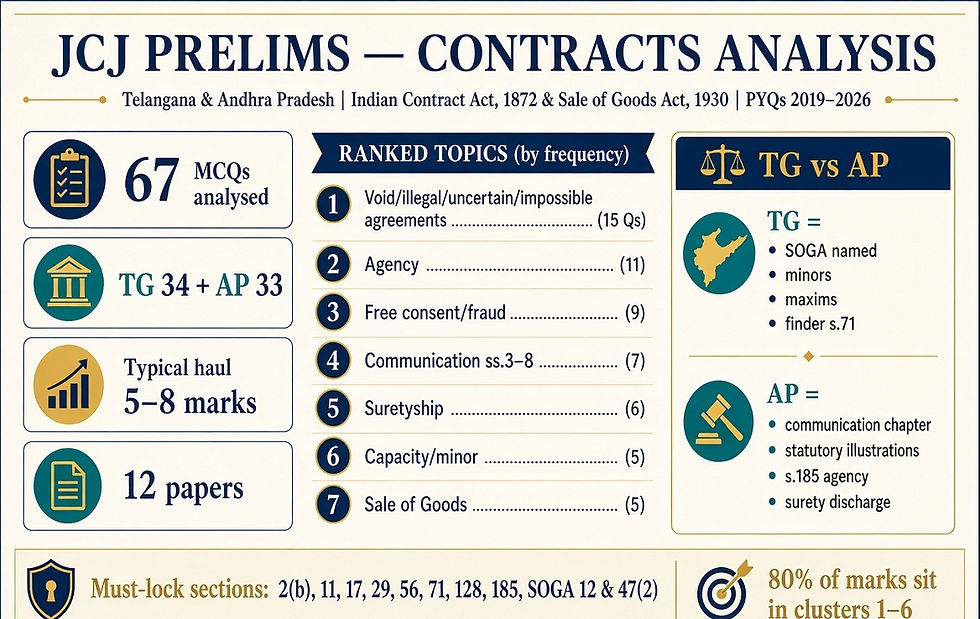
Questions analysed | 67 MCQs (TG 34 + AP 33) |
Primary source | Compiled PYQ book (Aravind Rao) |
Purpose | Weightage, repeats, high-yield sections, traps, plan |
Prepared | September 2026 |
This note is an analytical brief, not a substitute for the bare Act. Every conclusion below is drawn from the actual wording of the compiled papers. Where a paper cited a wrong section number, that slip is flagged so it is not reproduced in the exam hall.
1. How this paper sits in the JCJ scheme
Both High Courts treat the Preliminary Examination as a 100-question, 100-mark, two-hour screening test. Marks do not go into the final merit. The cut-off is typically 40 per cent. Contract law is not a standalone paper; it is one civil subject inside a mixed civil–criminal MCQ paper.
The official syllabus language differs slightly, and that difference matters for preparation:
• Telangana: “Indian Contract Act, 1872 and Sale of Goods Act.” SOGA is expressly in the TG syllabus and has been examined (caveat emptor, condition/warranty, unpaid seller’s lien).
• Andhra Pradesh: lists “Indian Contract Act, 1872.” SOGA is not named as a separate Act, but AP still asks questions that live in the repealed Chapter VII of the Contract Act (warranty, resale) and statutory illustrations that now sit in SOGA. Treat SOGA as a short, high-return add-on for AP as well.
From the 2026 TG paper discussion in the public domain, Contract contributed about five questions in a 100-mark paper. That is consistent with the compiled book: TG has ranged from 3 to 9 Contract/SOGA questions a year; AP from 4 to 8. A working planning figure is 5–8 marks. That is enough to decide a screening cut-off, not enough to justify reading Pollock & Mulla cover to cover.
Planning number Target 5–8 questions. If you can lock the 30 high-frequency sections listed in the exam-morning sheet (Part 12 of this note), you should convert 80–90 per cent of the Contract questions that actually appear. |
2. Year-wise harvest from the compiled papers
2.1 Telangana
Year | Qs | Tone of the paper | Stand-out feature |
2019 | 5 | Definition-heavy | s.2(b)/(c)/(i); agent s.182; s.12 unsound mind |
2020 | 8 | Fact situations | Minor, agency death, s.70, surety, non est factum |
2022 | 4 | Short and statutory | s.11 competence, novation s.62, finder s.71, s.2(b) |
2023 | 3 | Thin paper | Voidable option; public policy; free consent s.14 |
2024 | 9 | Heaviest TG year | Wager v contingent; s.57; s.29; fraud; SOGA trio; minor restitution; s.128 |
2026 | 5 | Classic void-cluster | ss.26/30/56; finder s.71; unauthorised agent; fraud s.17(4); s.56 |
TG 2024 is the year to treat as the ceiling. Nine questions, three of them SOGA, plus the “restitution stops where repayment begins” maxim. A candidate who prepared only the first 75 sections of the Contract Act would have dropped the SOGA block.
2.2 Andhra Pradesh
Year | Qs | Tone of the paper | Stand-out feature |
2020 | 5 | Communication + void | s.4 letter; revocation s.6; s.16 dominate; dead dog s.20; magic s.56 |
2021 | 4 | Contingent + offer | s.35 incorrect statement; s.6 condition precedent; s.29 horse price; s.185 |
2022 | 5 | Definitions + case | s.2(e); s.25 no consideration; Balfour; s.11; silence not fraud |
2023 | 4 | Special contracts | Clayton ss.59–61; indemnity of agent s.222; lien s.170; agency s.185 |
2024 | 8 | Illustrations paper | Cow-calf s.163; drop prosecution s.23; s.128; agency trio; s.137; s.8; horse silence; s.19 |
2026 | 7 | Guarantee + history | s.127; oil uncertainty s.29; s.3; warranty repealed to SOGA; s.72; Ch.VII; s.125 |
AP examiners love the statutory illustration. If the illustration is printed in the Act (oil of several kinds, horse at auction, cow and calf, dead dog, treasure by magic, dropping a robbery prosecution), it has already been asked or is waiting. AP 2026 also tested legislative history: which chapter of the 1872 Act migrated into the 1930 Sale of Goods Act.
2.3 Combined volume
State | Years in the book | Questions | Average / year |
Telangana | 6 (2019–26, no 2021 paper in the book) | 34 | 5.7 |
Andhra Pradesh | 6 (2020–26) | 33 | 5.5 |
Combined | 12 papers | 67 | 5.6 |
3. Topic-wise frequency — where the marks actually sit
The 67 questions collapse into a surprisingly small set of doctrinal boxes. Frequency below is a question-count, not a unique-section count. One question can touch two boxes (for example, minor + promissory note).
Rank | Topic cluster | TG | AP | Total | Core sections |
| |
1 | Void / illegal / uncertain / impossible agreements | 8 | 7 | 15 | ss.23, 26, 29, 30, 56, 57 |
| |
2 | Agency (creation, authority, death, indemnity, personal liability) | 5 | 6 | 11 | ss.182, 185–186, 201, 213, 222, 230, 235 |
| |
3 | Free consent — fraud, coercion, undue influence, misrepresentation | 5 | 4 | 9 | ss.14–19 |
| |
4 | Capacity — minor and unsound mind | 4 | 1 | 5 | ss.11–12; Mohori Bibee |
| |
5 | Guarantee, indemnity, surety | 2 | 4 | 6 | ss.125–128, 137 |
| |
6 | Offer, acceptance, communication, revocation | 2 | 5 | 7 | ss.2–8 |
| |
7 | Bailment, finder, lien, increase of goods | 2 | 2 | 4 | ss.71, 163, 170 |
| |
8 | Sale of Goods (condition, caveat emptor, unpaid seller, repeal) | 3 | 2 | 5 | SOGA ss.12, 16, 47; ICA Ch.VII |
| |
9 | Quasi-contract / restitution (ss.68–72) | 2 | 1 | 3 | ss.70, 72 |
| |
10 | Consideration and intention to create legal relations | 0 | 2 | 2 | s.25; Balfour |
| |
11 | Discharge — novation / appropriation | 1 | 1 | 2 | ss.59–62 |
| |
12 | Contingent contracts | 1 | 1 | 2 | ss.31–35 |
| |
13 | Maxims / non est factum / restitution maxim | 2 | 0 | 2 | — |
| |
| The 80-per-cent rule Clusters 1 to 6 account for roughly 53 of 67 questions. If time is short, master void agreements, agency, free consent, capacity, suretyship and the communication chapter. Add SOGA only after those six are cold. | ||||||
4. High-yield sections — a ranked hit list
A section is “high-yield” if it has been asked more than once, or if its statutory illustration has been reproduced almost verbatim. Learn the black-letter text, not a paraphrase.
4.1 Asked more than once (must-know)
Section | Proposition tested | Papers |
s.11 | Competence: majority + sound mind + not disqualified. Minor’s agreement void ab initio. | TG 2020, 2022; AP 2022 |
s.17 | Fraud includes a promise made without intention to perform; silence at auction is not fraud. | TG 2024, 2026; AP 2022, 2024 |
s.29 | Agreement void for uncertainty — “a sum of money”; “100 tons of oil”; “Rs.500 or Rs.1,000”. | TG 2024; AP 2021, 2026 |
s.56 | Agreement to do an act impossible in itself is void (magic treasure). | TG 2026 (twice); AP 2020 |
s.71 | Finder of goods is subject to the same responsibility as a bailee. | TG 2022, 2026 |
s.128 | Surety’s liability is co-extensive with the principal debtor unless otherwise provided. | TG 2020, 2024; AP 2024 |
s.185 | No consideration is necessary to create an agency. | AP 2021, 2023, 2024 |
s.70 | No compensation where the act was intended to be gratuitous. | TG 2019, 2020 |
s.2(b) | A proposal when accepted becomes a promise. | TG 2019, 2022 |
SOGA s.12 / ICA warranty history | Condition vs warranty; warranty chapter moved to SOGA. | TG 2024; AP 2026 |
4.2 Asked once but almost certain to return
• s.3 — communication of proposal, acceptance and revocation is by act or omission (AP 2026).
• s.4 — communication of a proposal is complete when it comes to the knowledge of the offeree (letter reaches B) (AP 2020).
• s.6 — modes of revocation, including failure of a condition precedent to acceptance (AP 2020, 2021). Note: “refusal by the acceptor” is not listed in s.6 as revocation of the proposal.
• s.8 — performance of conditions, or acceptance of consideration for a reciprocal promise, is acceptance (AP 2024).
• s.12 — person usually of unsound mind may contract during a lucid interval (TG 2019; the paper had a flagged discrepancy).
• s.14 — free consent is consent not caused by coercion, undue influence, fraud, misrepresentation or mistake (TG 2023).
• s.16 — undue influence: position to dominate the will + unfair advantage. The statutory verb is “dominate” (AP 2020).
• s.19 / 19A — agreement caused by coercion, fraud or misrepresentation is voidable at the option of the party whose consent was so caused (typically the promisee) (TG 2023; AP 2024).
• s.20 — bilateral mistake as to an essential fact (dead dog) renders the agreement void (AP 2020).
• s.23 ill.(h) — promise to drop a prosecution for robbery in return for restoration of the goods is void (AP 2024).
• s.25 — agreement without consideration is void, subject to the three exceptions (AP 2022).
• s.26 — agreement in restraint of marriage is void (TG 2026).
• s.30 vs ss.31–32 — wager is void; contingent contract is valid but unenforceable until the event happens (TG 2024).
• s.35 — contingent contract to do something if an event happens within a fixed time becomes void if the event has not happened when time expires (AP 2021 set a false statement of this rule).
• ss.59–61 — Clayton’s rule of appropriation of payments (AP 2023).
• s.62 — novation is substitution of a new contract for the old (TG 2022).
• s.72 — goods delivered by mistake; if the recipient treats them as his own he must compensate (AP 2026).
• s.125 — indemnity-holder may recover damages he is compelled to pay (AP 2026).
• s.127 — anything done for the benefit of the principal debtor is sufficient consideration for the guarantee (AP 2026).
• s.137 — mere forbearance to sue the principal debtor does not discharge the surety (AP 2024).
• s.163 — bailee must deliver increase or profit (cow and calf) (AP 2024).
• s.170 — bailee’s particular lien (AP 2023).
• s.182 — definition of agent (TG 2019).
• s.186 — authority of agent may be express or implied (AP 2024; the false statement was that authority must always be express).
• s.201 — agency terminates on death of principal or of agent (TG 2020 twice).
• s.213 — agent must render proper accounts on demand (AP 2024).
• s.222 — principal must indemnify the agent for lawful acts (AP 2023).
• ss.230 and 235 — agent who contracts without authority, and whose alleged principal repudiates, is personally liable (TG 2026).
• SOGA s.16 — caveat emptor (TG 2024).
• SOGA s.47(2) — unpaid seller may exercise lien even when in possession as agent or bailee for the buyer (TG 2024).
5. Repeated fact-patterns — learn the illustration, not the story
Examiners recycle the Act’s own illustrations. When you see one of the following stems, you should be able to write the section number before you finish reading the options.
Stem you will recognise | Section / case | Correct legal result |
Dealer in several oils agrees to sell “100 tons of oil” | s.29 | Void for uncertainty |
Horse for “Rs.500 or Rs.1,000” | s.29 | Void for uncertainty |
Promise to pay “a sum of money” if cement is supplied | s.29 | Void for uncertainty |
Discover treasure by magic | s.56 | Void — impossible in itself |
Dog / subject-matter already dead; neither party knows | s.20 | Void — bilateral mistake of fact |
Auction of unsound horse; seller silent; no duty to speak | s.17 illustration | Not fraud |
Cow bailed; calf born | s.163 | Bailee must deliver cow and calf |
Goods left at B’s house by mistake; B uses them | s.72 | B must compensate A |
Z saves Y’s property from fire intending it to be free | s.70 | Z gets no compensation |
A promises to drop robbery prosecution; B restores goods | s.23 ill.(h) | Void — unlawful object |
Minor occupies house, pays part, gives a promissory note | s.11; Mohori Bibee | Agreement and note both unenforceable |
Power of attorney; principal dies; agent executes sale later | s.201 | Sale is without authority — invalid |
C & D stand surety; A defaults | s.128 | Creditor may sue A, or C and D, or all |
Creditor waits a year without suing the debtor | s.137 | Surety is not discharged |
6. Telangana versus Andhra Pradesh — how the two papers differ
6.1 Shared DNA
Both papers are statute-literal. They prefer the exact verb of the section (“dominate”, “co-extensive”, “promise”, not “contract”) over academic paraphrase. Both punish candidates who confuse void with voidable, condition with warranty, wager with contingent contract, and agent with principal. Both recycle illustrations.
6.2 Where they diverge
Feature | Telangana | Andhra Pradesh |
SOGA | Named in the syllabus; 3 direct SOGA questions in 2024 alone. | Not named, but 2026 tested the repeal of the sale-of-goods chapter and “warranty”. |
Capacity / minor | Heavier. Two minor questions in 2020 plus the restitution maxim in 2024. | One clean s.11 competence question (2022). |
Agency death / personal liability | Fact-heavy: GPA after death of principal; unauthorised agent sued alone. | Doctrine-heavy: consideration not needed; express or implied authority; accounts; indemnity of agent. |
Communication chapter | Almost untouched after 2019 definitions. | A favourite: ss.3, 4, 6, 8 across 2020–26. |
Suretyship | s.128 twice, framed as “whom can the creditor sue”. | ss.127, 128, 137 — consideration for guarantee and discharge. |
Maxims and Latin | Lex non cogit ad impossibilia; non est factum; restitution maxim. | Almost none. One English case: Balfour v. Balfour. |
Question style | Mix of “which are void” lists and short facts. | Often “with reference to Section X, select the correct option” plus the illustration copied out. |
Volume spike | 2024 (9 Qs) is the outlier. | 2024 (8) and 2026 (7) are the recent ceiling. |
Practical consequence: a TG candidate who ignores SOGA and the minor-restitution line is under-prepared. An AP candidate who ignores ss.3–8 and the suretyship chapter is under-prepared. A candidate sitting both papers should treat the union of the two lists as the syllabus.
7. Chapter-wise doctrinal map (tied to the PYQs)
7.1 Preliminary — ss.1–2 (definitions)
Three definition questions have already been asked. Memorise the exact pairings:
• s.2(b): proposal + acceptance = promise (not “contract”, not “agreement”). TG 2019, 2022.
• s.2(c): the person making the proposal is the promisor; the person accepting is the promisee. The 2019 incorrect statement was that the acceptor is the promisor.
• s.2(e): every promise and every set of promises forming consideration for each other is an agreement. AP 2022.
• s.2(h): an agreement enforceable by law is a contract. Used as a true statement in TG 2019.
• s.2(i): voidable contract = enforceable at the option of one or more parties but not at the option of the other or others. TG 2019.
Trap: “every valid agreement is enforceable through courts” is true only if “valid” is being used as a synonym for “contract”. TG 2023 used a cleaner incorrect statement: an agreement opposed to public policy is enforceable.
7.2 Communication of proposals — ss.3–9
This is an AP stronghold. The sequence to keep straight:
• s.3 — communication is by any act or omission that is intended to communicate, or that has the effect of communicating.
• s.4 — communication of a proposal is complete when it comes to the knowledge of the person to whom it is made. A’s letter to sell a house is complete when B receives it — not when A posts it.
• s.5 — proposal may be revoked at any time before the communication of its acceptance is complete as against the proposer.
• s.6 — revocation happens by notice; by lapse of prescribed (or reasonable) time; by failure of a condition precedent to acceptance; by death or insanity of the proposer, if the fact comes to the acceptor’s knowledge before acceptance. “Refusal by the acceptor” is not a s.6 mode of revoking the proposal; it is a failure of acceptance.
• s.7 — acceptance must be absolute and unqualified.
• s.8 — performing the conditions of a proposal, or accepting any consideration for a reciprocal promise offered with a proposal, is an acceptance.
Do not confuse the postal rules of s.4 (acceptance complete against the proposer when the letter is posted; against the acceptor when it comes to the proposer’s knowledge). That distinction has not yet been asked in this compilation, which makes it a live candidate.
7.3 Competence — ss.10–12
s.10 is the gateway (free consent, competent parties, lawful consideration and object, not expressly declared void). s.11 is the competence triad: age of majority according to the law to which he is subject; sound mind; not disqualified by any law to which he is subject. The 2022 AP paper tested the last limb with the exact phrase “not disqualified”.
Mohori Bibee v. Dharmodas Ghose (1903) is the only case you must be able to name without thinking. A minor’s agreement is void ab initio. It is not voidable at the minor’s option. A promissory note executed by the minor does not cure the defect. Occupation of the premises and part-payment do not estop the minor. TG 2020 asked this twice in one paper — once as a clean age-16 contract, once as a tenancy-plus-promissory-note problem.
The restitution maxim “restitution stops where repayment begins” (Leslie v. Sheill) was asked in TG 2024 and applied “against minors only”. Limited restitution of identifiable property may be ordered; a personal decree to repay as on a contract may not.
s.12: a person who is usually of unsound mind may contract when he is of sound mind. TG 2019 asked this; the source note says the question was ignored for all candidates because of a discrepancy. Still learn the rule.
7.4 Free consent — ss.13–22
s.13 defines consent as agreement upon the same thing in the same sense (consensus ad idem). s.14 lists the five vitiating factors. Questions have landed on four of the five:
• Coercion (s.15) / s.19: voidable at the option of the party whose consent was so caused. AP 2024.
• Undue influence (s.16): the statutory phrase is “dominate the will”. AP 2020. Relations that raise a presumption (parent and child, fiduciary, doctor and patient) have not yet been asked as a list — a likely future question.
• Fraud (s.17): five heads, of which three have been used as options: suggestion of a fact that is not true; active concealment; promise made without any intention of performing it; any other act fitted to deceive; any act or omission the law specially declares to be fraudulent. Silence is not fraud unless there is a duty to speak, or unless silence is itself equivalent to speech. The unsound horse at auction is the set illustration — asked in AP 2022 and AP 2024, and the complementary “promise without intention” head was asked in TG 2024 and TG 2026.
• Misrepresentation (s.18): has appeared only as a distractor. Know the difference: fraud requires intent to deceive; misrepresentation does not.
• Mistake (ss.20–22): bilateral mistake of essential fact = void (dead dog, s.20). Mistake of Indian law is not an excuse (s.21). Unilateral mistake does not make the contract void (s.22). Only s.20 has been asked.
Voidable contracts (ss.19–19A) may be enforced or avoided at the option of the party whose consent was not free — in the papers, “the promisee”. They do not become contracts “with the consent of both” or “at the option of the promisor”.
7.5 Void agreements — ss.23–30, 56–58
This is the single densest scoring area. Keep a clean taxonomy:
• s.23 — consideration or object unlawful if it is forbidden by law, would defeat a law, is fraudulent, involves injury to person or property, or is immoral or opposed to public policy. Illustration (h) — compounding a robbery prosecution — AP 2024. TG 2023 used “opposed to public policy is enforceable” as the incorrect statement.
• s.26 — restraint of marriage of any person other than a minor is void. TG 2026 bundled it with s.30 and s.56.
• s.27 — restraint of trade. Not asked in this compilation. Still learn the exceptions (sale of goodwill; partnership). It is too famous to stay unasked.
• s.28 — restraint of legal proceedings. Not asked. Same comment.
• s.29 — uncertainty. Three different illustrations already used. If the meaning is not certain or capable of being made certain, the agreement is void.
• s.30 — wager is void. Distinguish from contingent contracts (ss.31–36): a contingent contract is valid, but cannot be enforced until the event happens (or becomes impossible, depending on the form). TG 2024 asked the distinction directly. One option said “the latter cannot be enforced till the event happened” — that is the correct contrast they wanted, even though it is a compressed statement of ss.32–33.
• s.56 — agreement to do an act impossible in itself is void. Subsequent impossibility / frustration is the second paragraph. Only initial impossibility has been asked. Lex non cogit ad impossibilia was the maxim vehicle in TG 2020.
• s.57 — reciprocal promises to do things legal and also things illegal: the first set is a contract, the second is a void agreement. TG 2024.
7.6 Contingent contracts — ss.31–36
Definition (s.31): a contract to do or not to do something if an event collateral to such contract does or does not happen. Enforcement rules:
• s.32 — if the event happens; cannot be enforced unless the event has happened.
• s.33 — if the event does not happen; can be enforced when the event becomes impossible.
• s.34 — event depending on a person doing something in the manner he pleases: the event is considered impossible if he does something that makes it impossible.
• s.35 — event within a fixed time: becomes void if the time expires and the event has not happened. AP 2021 planted the false statement that it becomes void if the event has happened.
• s.36 — impossible events: void.
7.7 Performance, discharge, appropriation — ss.37–67
Thinly tested, therefore dangerous if ignored:
• ss.59–61 (Clayton’s rule): debtor may appropriate; failing that the creditor may appropriate; failing both, appropriation is in order of time. AP 2023 asked which sections embody the rule. Options included ss.57–58, 62–63 and 65–66 to catch candidates who confuse appropriation with novation and with restitution after a void contract.
• s.62 novation, rescission, alteration: if the parties agree to substitute a new contract, or to rescind or alter it, the original need not be performed. TG 2022. Novation is not mere renewal, not mere cancellation, not mere alteration — it is substitution.
• s.63 (promisee may dispense with or remit performance) and s.64–65 (consequences of rescission / restitution of advantage under a void agreement) have not been asked. s.65 is a natural companion to the minor and void-agreement questions and should be prepared.
7.8 Quasi-contracts — ss.68–72
• s.70: person who enjoys the benefit of a non-gratuitous lawful act must compensate. The fire-rescue illustration is used to test the negative — if the saver intended the act to be gratuitous, s.70 does not apply. Asked twice in TG (2019 and 2020) with identical facts.
• s.71: finder of goods = bailee. Asked twice in TG (2022, 2026).
• s.72: person to whom money is paid or goods delivered by mistake or under coercion must repay or return. Goods left at B’s house by mistake; B treats them as his own — he must compensate. AP 2026.
s.68 (necessaries supplied to a person incapable of contracting) is the natural partner of the minor questions and has not yet been asked in this set. Prepare the illustration of necessaries and the rule that only a reasonable price is recoverable, and only from the minor’s property.
7.9 Indemnity and guarantee — ss.124–147
Rising in AP (2024 and 2026). The minimum kit:
• s.124 / 125: indemnity is a contract to save from loss caused by the promisor’s own conduct or by the conduct of another. The indemnity-holder, acting within authority, recovers damages he is compelled to pay, costs, and sums paid under a compromise. AP 2026 used “damages paid in matter of indemnity” as the accepted option.
• s.126: guarantee is a contract to perform the promise or discharge the liability of a third person in case of his default. Three parties: principal debtor, creditor, surety.
• s.127: anything done, or any promise made, for the benefit of the principal debtor is sufficient consideration for the guarantee. AP 2026.
• s.128: liability of the surety is co-extensive with that of the principal debtor unless otherwise provided. Creditor may sue the principal, the sureties, or all. TG 2020 framed it as “any of the above”; TG 2024 and AP 2024 asked the co-extensive formula itself.
• s.133–139 discharge of surety: only s.137 has been asked — mere forbearance to sue does not discharge. Still learn s.133 (variance), s.134 (release of principal), s.135 (composition / giving time), s.139 (impairing surety’s remedy). These are the next obvious questions.
s.140–141 (surety’s rights on payment) and s.146–147 (co-sureties) have not been asked. One question from that pocket is a fair prediction.
7.10 Bailment — ss.148–181
• s.148: bailment is delivery of goods for some purpose, upon a contract that they shall be returned or disposed of according to the bailor’s directions.
• s.163: in the absence of a contract to the contrary, the bailee must deliver any increase or profit. Cow and calf — AP 2024. Options that let B keep the calf, or choose one animal, are wrong.
• s.170: bailee’s particular lien — AP 2023 asked the title of the section. Know that it is a particular lien (only for the goods bailed in respect of which the bailee has rendered service), not a general lien. General lien of bankers, factors, wharfingers, attorneys and policy-brokers is s.171 — not yet asked.
• s.171 general lien, s.172–179 pledge, s.180–181 pawnor/pawnee rights: untouched in this compilation. Pledge is the most likely next arrival because it is short and illustration-rich.
7.11 Agency — ss.182–238
Second-highest cluster. A compact statute map that covers every question already asked:
• s.182 definition: person employed to do any act for another or to represent another in dealings with third persons. TG 2019.
• s.183: any person who is of the age of majority and of sound mind may employ an agent. A minor cannot appoint an agent — this was the rejected option in AP 2023.
• s.184: as between principal and third persons, any person may become an agent (even a minor), but a minor agent is not responsible to the principal.
• s.185: no consideration is necessary to create an agency. Asked three times in AP.
• s.186: authority may be express or implied. The statement “authority must always be expressed only” is false. AP 2024.
• s.201 termination: by revocation, renunciation, business completed, death or insanity of principal or agent, insolvency of principal. Death of principal or agent was asked twice in TG 2020, once as a clean MCQ and once as a GPA-after-death sale.
• s.213: agent must render proper accounts to the principal on demand. AP 2024.
• s.222: principal must indemnify the agent against consequences of lawful acts done in exercise of authority. AP 2023.
• ss.226–238 and third-party relations: ss.230 and 235 were used in TG 2026. An agent who contracts as agent for a named principal is not personally bound (s.230), but a person untruly representing himself as agent, whose alleged principal repudiates, is personally liable (s.235). On those facts only B could be sued.
Sub-agent (ss.190–195) and pretence of authority beyond the two sections above have not been asked. One sub-agent question is a fair prediction.
7.12 Sale of Goods Act, 1930 — mandatory for TG, useful for AP
TG 2024 asked three SOGA questions in one paper. AP 2026 asked two questions about the legislative move from ICA Chapter VII to SOGA. The minimum SOGA kit for JCJ prelims is small:
• s.4: sale v agreement to sell — property passes vs property to pass. Not yet asked; highly examinable.
• s.12: condition is a stipulation essential to the main purpose of the contract; warranty is collateral. Breach of condition gives a right to reject; breach of warranty gives a right to damages. TG 2024.
• s.16: caveat emptor — there is no implied warranty or condition as to quality or fitness except the listed exceptions (fitness for disclosed purpose, merchantable quality on description from a dealer, usage of trade, implied by circumstances). TG 2024 asked only the home of the doctrine.
• ss.45–54 unpaid seller: lien, stoppage in transit, resale. s.47(2) — lien may be exercised even where the seller is in possession as agent or bailee for the buyer. TG 2024. AP 2026 asked which repealed ICA chapter contained the resale provisions (Chapter VII).
• Warranty as a concept: AP 2026 asked what was repealed from the Contract Act and is now in SOGA. The correct option was “Warranty”, not frustration, fraud or mistake as to law.
Do not sink time into SOGA auction rules, CIF/FOB, or hire-purchase. Those have not been the JCJ style.
8. Cases, maxims and “which statement is incorrect” craft
8.1 Cases that have actually appeared
Authority | Proposition used in the paper | Where |
Mohori Bibee v. Dharmodas Ghose (1903) | Minor’s agreement is void ab initio | TG 2020 (twice in spirit); TG 2024 restitution |
Leslie Ltd v. Sheill (1914) | Restitution stops where repayment begins — no personal decree against the minor to repay as on a contract | TG 2024 |
Balfour v. Balfour [1919] 2 KB 571 | No contract without intention to create legal relations (domestic arrangement) | AP 2022 (option misspelt “Belfour”) |
Cases that are one step away and should be known by name: Carlill v. Carbolic Smoke Ball Co. (unilateral offer — already an option in AP 2022); Harvey v. Facey (supply of information is not an offer — also an option); Lalman Shukla v. Gauri Dutt (acceptance needs knowledge of the offer); Felthouse v. Bindley (silence is not acceptance); Hadley v. Baxendale (remoteness — more a mains case); Satyabrata Ghose v. Mugneeram Bangur (Indian frustration).
8.2 Maxims
• Lex non cogit ad impossibilia — the law does not compel the performance of impossibilities. TG 2020. Options that said the law “compels” impossibilities or immoral acts are there to catch a rushed reading.
• Non est factum — “it is not my deed.” Lets a party deny that the instrument is his act. TG 2020 framed the option as “instrument is nothing to act and allows the party to escape performance of contract”.
• Restitution stops where repayment begins — minors only, on the compiled key. TG 2024.
8.3 The “incorrect statement” genre
TG 2019, TG 2023 and AP 2021 all used a “which is NOT true / INCORRECT” stem. The wrong statement is usually a one-word inversion of a well-known rule (acceptor called promisor; public-policy agreement called enforceable; contingent contract called void when the event has happened rather than when it has not). Train yourself to underline the negative in the stem before you look at the options.
9. Examiner traps that have already cost marks
• Void vs voidable. Minor, uncertainty, impossibility, wager, restraint of marriage, unlawful object = void. Coercion, fraud, misrepresentation, undue influence = voidable. This single distinction decides at least eight questions in the book.
• Promise vs contract vs agreement. s.2 is merciless. Accepted proposal = promise. Mutual promises = agreement. Enforceable agreement = contract.
• Wrong section cited in the stem. AP 2022 attributed the unsound-horse illustration to “Section 7”. The illustration belongs to s.17. Answer from doctrine, not from the section number printed in the question if the two collide.
• Gratuitous vs non-gratuitous under s.70. The fire-rescue facts are written to look like a hard-luck quasi-contract. The word “gratuitously” is the whole question.
• Silence as fraud. Default rule is no. Duty to speak, or silence equivalent to speech, is the exception. Auction of a horse is the default-rule illustration.
• Surety’s liability is co-extensive, not secondary, not parallel. “Secondary” is the common-law instinct and the wrong option.
• Agency survives the principal’s death? No. s.201. A registered GPA does not keep the agency alive after death.
• Condition precedent to acceptance (s.6) vs condition in a concluded contract. AP 2021 used a three-year deposit as a condition precedent to acceptance of a lease offer. Remedy is revocation of the proposal, not specific performance.
• SOGA possession as agent/bailee. s.47(2) is a trap for anyone who thinks lien needs the seller to be “seller in possession as seller”.
10. What has not been asked — the live prediction list
A topic that is in the Act, is short, has a famous illustration, and has not appeared in twelve papers is more valuable than a topic that has already been asked four times. In descending order of probability:
• s.27 restraint of trade, and the goodwill exception.
• s.28 restraint of legal proceedings / ouster of jurisdiction.
• Postal rule of acceptance (s.4 second clause) and revocation of acceptance.
• s.68 necessaries supplied to a minor.
• s.65 restitution of advantage under a void agreement (pairs with every minor and uncertainty question).
• s.73 measure of damages; s.74 liquidated damages and penalty (more mains-flavoured, but a one-line MCQ is possible).
• Discharge of surety by variance (s.133) and by giving time (s.135).
• Pledge (ss.172–179) — definition, pawnee’s rights on default.
• s.171 general lien of bankers, factors, wharfingers, attorneys, policy-brokers.
• Sub-agent vs substituted agent (ss.190–195).
• Ratification (ss.196–200).
• SOGA s.4 sale versus agreement to sell; s.19–20 passing of property; unpaid seller’s stoppage in transit (s.50).
• Specific Relief Act interface: specific performance of a contract vs damages. Out of syllabus as a named Act on some lists, but the factual overlap is real.
• Privity of contract / consideration moving from the promisee (s.2(d)) — still unasked in this set.
11. How to study this subject for a 5-to-8-mark slot
11.1 What not to do
Do not start with a 1,200-page commentary. Do not make 80 pages of notes. Do not treat Contract as if it were a university LL.B. paper. The examiner is testing whether you can recognise the section and the illustration in 60 seconds.
11.2 A working method
• Bare Act first, twice. Read ss.1–75 and ss.124–238 of the Contract Act and ss.2–17 and 45–54 of SOGA with every illustration. That is the entire examinable surface for prelims.
• Mark the PYQ sections in the margin. After one reading of this note, every section in Chapter 4 should have a year-tag in your bare Act.
• Drill the 14 recycled stems in Chapter 5 until you can name the section with the book closed.
• Keep a one-page “void / voidable / valid” sheet. Write every section that produces each result. This sheet alone is worth four marks a year.
• Do mixed MCQs, not chapter-wise MCQs, in the last two weeks. The real paper jumps from agency to wager to SOGA without a heading.
• For mains (after prelims): shift to problem questions on minors, frustration, suretyship and damages. That is a different skill and should not contaminate prelims revision.
11.3 A 12-day Contract block (inside a longer prelims plan)
Day | Task | Output |
1–2 | Bare Act ss.1–30 with illustrations | Definition flash-cards; void-agreement list |
3 | ss.31–67 (contingent, performance, novation, appropriation) | Clayton / novation distinction card |
4 | ss.68–75 and damages overview | s.70 / 71 / 72 trio card |
5 | Indemnity & guarantee ss.124–147 | Co-extensive liability + three discharge sections |
6 | Bailment & pledge ss.148–181 | Cow-calf + particular v general lien |
7 | Agency ss.182–238 | s.185 / 201 / 230 / 235 card |
8 | SOGA ss.2–17, 45–54 | Condition / caveat emptor / unpaid seller |
9 | All PYQs in this compilation, timed | Error log of traps you actually fell for |
10 | Untested-but-likely list in Chapter 10 | One-line notes only |
11 | Mixed 40-question drill (TG + AP style) | Accuracy target 85%+ |
12 | Bare Act speed-read of flagged sections only | Exam-morning sheet of 30 sections |
12. Thirty-section exam-morning sheet
If you can recite the proposition against each of these, you are prelims-ready on this subject.
No. | Section | One-line proposition |
1 | s.2(b) | Accepted proposal = promise |
2 | s.2(e) | Promises forming consideration for each other = agreement |
3 | s.2(i) | Voidable = enforceable at the option of one side only |
4 | s.3 | Communication is by act or omission |
5 | s.4 | Proposal complete when it comes to offeree’s knowledge |
6 | s.6 | Revocation: notice / time / failed condition precedent / death |
7 | s.8 | Doing the requested act, or taking the offered consideration, is acceptance |
8 | s.11 | Major + sound mind + not disqualified; minor’s agreement void |
9 | s.12 | Usually unsound, but sound at the time = competent |
10 | s.14 | Free consent = not caused by the five vitiating factors |
11 | s.16 | Undue influence = dominate the will + unfair advantage |
12 | s.17 | Fraud includes a promise never meant to be kept; mere silence is not fraud |
13 | s.19 | Coercion / fraud / misrepresentation → voidable at victim’s option |
14 | s.20 | Bilateral mistake of essential fact → void |
15 | s.23 | Unlawful object / public policy / compounding prosecution → void |
16 | s.25 | No consideration → void (three exceptions) |
17 | s.26 / 30 | Restraint of marriage / wager → void |
18 | s.29 | Uncertain terms → void |
19 | ss.31–35 | Contingent contract valid; enforceability waits on the event |
20 | s.56 | Initial impossibility → void |
21 | s.57 | Legal set of reciprocal promises stands; illegal set is void |
22 | ss.59–62 | Clayton appropriation; novation = substitution |
23 | s.70 / 71 / 72 | Non-gratuitous benefit; finder = bailee; money/goods by mistake |
24 | s.125 / 127 / 128 / 137 | Indemnity damages; consideration for guarantee; co-extensive surety; forbearance ≠ discharge |
25 | s.163 / 170 | Increase of bailed goods; bailee’s particular lien |
26 | s.182 / 185 / 186 | Agent defined; no consideration needed; authority express or implied |
27 | s.201 / 213 / 222 | Death ends agency; accounts on demand; indemnity for lawful acts |
28 | ss.230 / 235 | True agent not personally bound; false agent is |
29 | SOGA s.12 / s.16 | Condition vs warranty; caveat emptor |
30 | SOGA s.47(2) | Unpaid seller’s lien survives possession as agent or bailee |
13. Closing assessment
Contract is a high-conversion, low-volume subject in both TG and AP JCJ prelims. The examiner is not looking for an essay on consideration theory. He is looking for the candidate who has read the illustrations and can tell void from voidable under time pressure.
The compiled papers from 2019 to 2026 show a stable centre of gravity: void agreements, agency, free consent, capacity, communication (especially AP), suretyship, and — for Telangana — a short SOGA module. That centre has not drifted. New questions will most likely be new illustrations of the same sections, or the first outing of the “not-yet-asked” list in Chapter 10.
Treat the bare Act as the only primary text. Use this analysis as a map of where the examiner has already walked, and therefore of where he is likely to walk again.

Comments